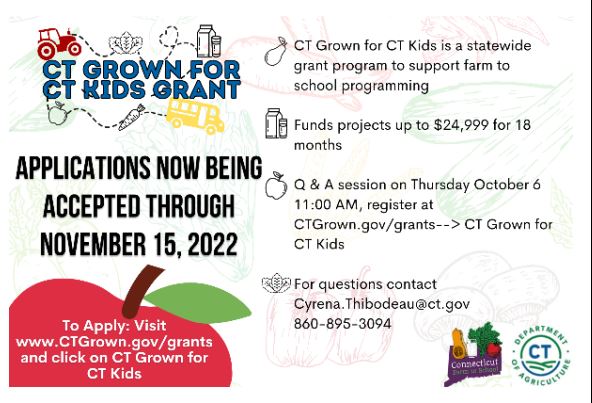
2023 CT Grown Free Downloadable Report Available
30
Apr2023 CT Grown Downloadable Report Available
Categories: News
Comments Off on 2023 CT Grown Downloadable Report Available
2023 CT Grown Free Downloadable Report Available
UConn DARE Zwick Center 2023 Farm to School Report available
Farm to school (FTS) programs across the State of Connecticut connect schools with fresh, local food producers. Using local procurement, school gardens, and education, these programs benefit both local producers and nutrition programs.
Click here for the downloadable report
Farm Business Management and Benchmarking (FBMB) Competitive Grants Program, due April 10, 2023
Farm Business Management and Benchmarking (FBMB) Competitive Grants Program improves the farm management knowledge and skills of agricultural producers by maintaining and expanding a national, publicly available farm financial management database to support improved farm management. The FBMB program supports intellectual talent and collaborative efforts to meet the challenges facing the nation’s agriculture and food systems. Application closes on April 10. For more information, read the FBMB funding opportunity
The Climate Smart Farming: Agriculture and Forestry Grant can fund projects in a variety of areas including, but not limited to:
Any agribusiness or entity, including nonprofit organization, soil and water conservation district, colleges and universities, municipality or for-profit organization in the State of Connecticut are eligible to apply.
All agricultural commodities can participate including aquaculture, agriculture and forestry. In addition, all production types will be supported including conventional/organic, indoor/outdoor, soil/water, and urban/rural.
CT DoAg plans to issue awards in varying amounts for program implementation from May 1, 2023, through May 1, 2028.
There will be four application funding tiers:
There is no match requirement for this grant.
|
|
|
The Northeast Dairy Business Innovation Center (NE-DBIC) and its partners offer grants, events, workshops, and educational opportunities to dairy farmers, processors, and service providers. Click here for more information.
LIVESTOCK OWNERS URGED TO BE AWARE OF EPIZOOTIC HEMORRHAGIC DISEASE (EHD) AFTER RECENT DETECTIONS IN
WHITE-TAILED DEER IN CONNECTICUT
The Connecticut Department of Agriculture (CT DoAg) is urging livestock owners to be aware of signs of epizootic hemorrhagic disease (EHD). This follows the recent announcement by Connecticut Department of Energy and Environmental Protection (DEEP) that EHD has been confirmed in white-tailed deer for the third year since first detected in our state in 2017. EHD is considered endemic in the United States and occurs sporadically, primarily in white-tailed deer. Because the disease is spread by biting Culicoides midges, the disease occasionally spills over to domestic livestock. Outbreaks of hemorrhagic disease are often associated with wet weather,
which provides breeding areas. Drought conditions which may concentrate animals and vectors around diminishing water sources may also be linked to some outbreaks occurring in the late summer and early fall due to an increase in midge numbers. Hemorrhagic disease outbreaks cease with the onset of a hard frost, which kills the midges carrying the virus.
For more information, click here.
The Connecticut Agricultural Mediation Program helps clients of USDA agencies and others in the Connecticut agricultural and rural communities resolve and manage disputes by providing mediation, facilitation, and training.
The Connecticut Agricultural Mediation Program (CTAMP), administered through the Quinnipiac University School of Law Center on Dispute Resolution, provides mediation and other conflict resolution services to Connecticut’s agricultural and rural community. Certified and sponsored by the United States Department of Agriculture (USDA), CTAMP’s services are available state-wide at little or no cost for USDA customers.
Mediation can provide many benefits, including helping to ensure that disagreements and disputes that threaten the economic success of farms are addressed quickly and confidentially.
CTAMP mediators can assist farmers, producers and other USDA customers to resolve the following issues:
Agricultural loans and loan-servicing, including Farm Service Agency and Rural Development loans
Adverse decisions from a USDA agency
Wetlands determination
Conservation compliance
Crop insurance
Pesticide application
Lease issues, including land leases and equipment leases
Family farm succession planning
National Organic Program established under the Organic Foods Production Act of 1990
Neighbor to neighbor disputes
Land use
Environmental concerns
Other issues as the Commissioner of the Connecticut Department of Agriculture considers appropriate for better serving the agricultural community and persons eligible for mediation
CTAMP provides low or no cost mediation services to the agricultural community for these issues. For other agricultural issues other funding sources may be available or we may ask parties to pay on a sliding scale.
CTAMP occasionally offers training opportunities and workshops in negotiation, conflict competency, facilitation, meeting management and succession planning to the agricultural community.
Click here to learn more or download a brochure.
CONNECTICUT DEPARTMENT OF AGRICULTURE ANNOUNCES NEW
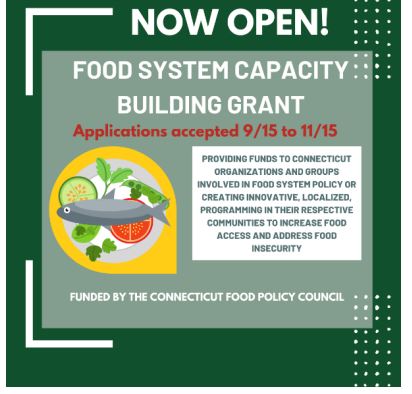
FUNDING OPPORTUNITY THROUGH FOOD POLICY COUNCIL
The Connecticut Department of Agriculture (DoAg) is pleased to announce the
competitive solicitation process to award The Food System Capacity Building
Grant provides funds to Connecticut organizations and groups involved in food
system policy or creating innovative, localized, programming in their respective
communities to increase food access and address food insecurity. Funding for
the Food System Capacity Building Grant is provided through the Connecticut
Food Policy Council under C.G.S. Sec. 22-456.
There is no minimum and the maximum amount of funds that can be requested
for one project is limited to $10,000.00. There is no match requirement for this
grant.
The application deadline is November 15, 2022, at 4:00 p.m. through the
Connecticut Department of Agriculture online application system.
Commissioner Bryan P. Hurlburt said, “During the COVID-19 pandemic, it
became clear that we needed to improve our food system, not only to make
more food available to families across the state, but to incorporate more CT
Grown products to offset the amount of food imported from out of state.
Through the efforts and commitment from the Food Policy Council, I’m happy to
announce the creation and availability of the Food System Capacity Building
Grant, which will improve the local food system and make food, particularly CT
Grown farm products, more accessible to Connecticut residents.”
Subscribe Past Issues Translate
9/30/22, 1:43 PM Climate Smart Agriculture