Assist New Milford in protecting and preserving our surviving farmlands

All posts in News

Farm Credit East announces 4/7/2016 $100,000 for Ag Education

Categories: News
Comments Off on Farm Credit East announces 4/7/2016 $100,000 for Ag Education

Farm Credit East announced 4/7/2016 $100,000 for Ag Education
farmcrediteast

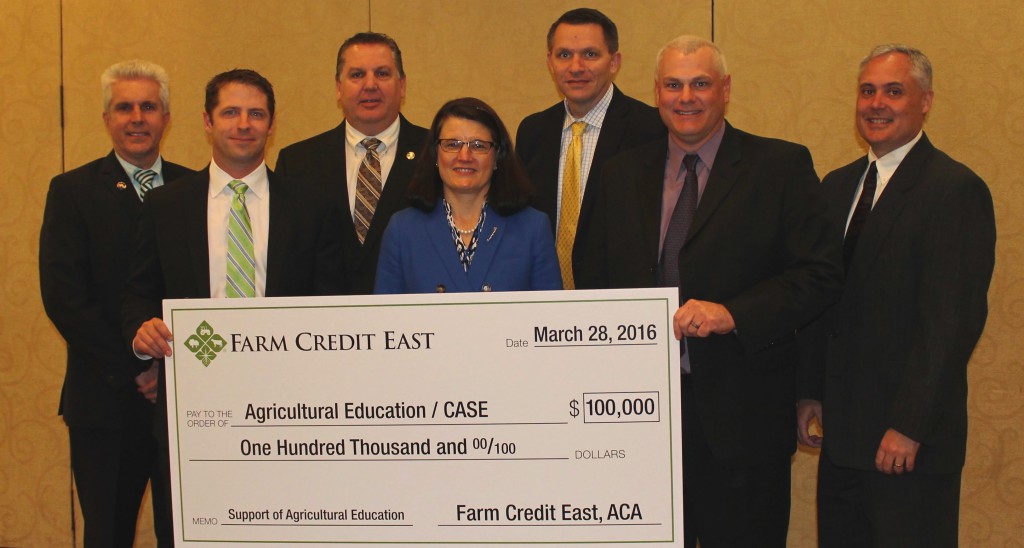
Photo Caption (L-R): Blane Allen, Farm Credit East Middletown, N.Y. branch office manager; Michael Brooks, Farm Credit East director and owner of Dusty Lane Farms in Elmer, N.J.; Scott Andersen, Farm Credit East Bridgeton, N.J. branch office manager; Nancy Trivette, Agricultural Education/CASE New Jersey program leader; Mike Reynolds, Farm Credit East executive vice president; Dr. Dan Jansen, Curriculum for Agricultural Science Education (CASE) project director; and Stephen Makarevich, Farm Credit East Flemington, N.J. branch office manager. (Courtesy Photo)

ENFIELD, Conn. — In honor of the Farm Credit System’s centennial year, Farm Credit East announced a $100,000 commitment to support the development of a new agricultural business curriculum and to provide scholarships for agriculture teachers.

“As we celebrate the centennial of the Farm Credit System we are looking towards the future. This investment in agricultural education delivers on that focus through programs to support the next generation of Northeast agriculture,” said Lisa Sellew, Farm Credit East director and chair of the Board’s AgInitiative Committee.

Farm Credit East has committed $50,000 toward the development of the agricultural business course of the Curriculum for Agricultural Science Education (CASE), a project of the National Association of Agricultural Educators. CASE courses integrate science, technology, engineering and math (STEM) concepts with hands-on, inquiry-based learning.

After an introductory course, students specialize in tracks for animal or plant science, power and technology and natural resources. Farm Credit East’s funding will help to develop a track in agricultural business. Since 2009, CASE has certified 1,134 teachers from 40 states, including 47 teachers from the Northeast states Farm Credit East serves.

“We appreciate Farm Credit East’s support for the development of the Agricultural Business Foundations course,” said Dan Jansen, CASE project director. “Given Farm Credit East’s financial expertise, it’s a great partnership. With their help, we can make the agricultural business course an outstanding addition.”

An additional $50,000 will go toward educator scholarships. Teachers become CASE certified through a rigorous 60-hour training institute. If a teacher in Farm Credit East’s territory is interested in a scholarship to support their attendance at a CASE institute, please visit farmcrediteast.com to apply.

—Farm Credit East

USDA Veterinary Loan Repayment program- Applications due May 20

Categories: News
Comments Off on USDA Veterinary Loan Repayment program- Applications due May 20

sonny

USDA Veterinary Loan Repayment program- Applications due May 20
“Veterinarians are critical to America’s food safety and security, as well as to the health and well-being of both animals and humans” said Dr. Sonny Ramaswamy, the NIFA Administrator. “There are significant shortages of veterinarians in areas of this country, and a leading cause is the heavy cost of four years of professional veterinary medical training, which leaves current graduates of veterinary colleges with an average debt of more than $135,000.” (U.S. Department of Agriculture, Flickr/Creative Commons)

WASHINGTON — The U.S. Department of Agriculture (USDA) today announced $4.4 million in available funding to help repay veterinary school loans in return for veterinarians serving in areas lacking sufficient veterinary resources. The funding is available through the Veterinary Medicine Loan Repayment Program (VMLRP), administered by USDA’s National Institute of Food and Agriculture (NIFA).

“Veterinarians are critical to America’s food safety and security, as well as to the health and well-being of both animals and humans” said Dr. Sonny Ramaswamy, the NIFA Administrator. “There are significant shortages of veterinarians in areas of this country, and a leading cause is the heavy cost of four years of professional veterinary medical training, which leaves current graduates of veterinary colleges with an average debt of more than $135,000.”

Recipients are required to commit to three years of veterinary service in a designated veterinary shortage situation. Loan repayment benefits are limited to payments of the principal and interest on government and commercial loans received while attending an American Veterinary Medical Association-accredited college of veterinary medicine resulting in a Doctor of Veterinary Medicine degree or the equivalent.

Participants are required to serve in one of three types of shortage situations. Awardees filling Type 1 shortages areas must dedicate at least 80 percent of their time to provision of food animal veterinary services. Type 2 shortages are rural areas in which awardees are obligated to provide food animal veterinary services at least 30 percent of their time. Type 3 shortage areas are dedicated to public practice and awardees must commit at least 49 percent of their time.

A map is available online describing each shortage area for FY 2016. Applications are dueMay 20. Please see the request for applications for more information.

In fiscal year 2015, NIFA received 137 applications and made 49 awards.

Since 2009, NIFA has invested in and advanced innovative and transformative initiatives to solve societal challenges and ensure the long-term viability of agriculture. NIFA’s integrated research, education, and extension programs, supporting the best and brightest scientists and extension personnel, have resulted in user-inspired, groundbreaking discoveries that are combating childhood obesity, improving and sustaining rural economic growth, addressing water availability issues, increasing food production, finding new sources of energy, mitigating climate variability, and ensuring food safety.   To learn more about NIFA’s impact on agricultural science, visit www.nifa.usda.gov/impacts, sign up for email updates, or follow us on Twitter @usda_NIFA,#NIFAimpacts.

New Milford Farmers’ Market to open May 7

Categories: News
Comments Off on New Milford Farmers’ Market to open May 7

farmersnm

The New Milford Farmers’ Market is set to open May 7 from 9 a.m. to 12 p.m. on the north end of the historic New Milford Green.  More information can be found on their website page: http://www.newmilfordfarmersmarket.com/

Northeast Agriculture Insights & Perspectives 2016 Report

Categories: News, Uncategorized
Comments Off on Northeast Agriculture Insights & Perspectives 2016 Report

Northeast Agriculture Insights & Perspectives 2016 Report

Recently released report from Farm Credit East. The report includes outlooks on several farming industries and provides economic outlooks from Chris Laughton, Farm Credit East Director of Knowledge, insights from Bill Lipinski, Farm Credit East CEO, and several industry.

The report can be viewed here.


Farmers Markets and Food-Borne Illness

Categories: News
Comments Off on Farmers Markets and Food-Borne Illness

New York Times on January 15, 2016
http://www.nytimes.com/2016/01/17/opinion/sunday/farmers-markets-and-food-borne-illness.html?_r=1

New Milford Farmland & Forest Preservation Committee 2016 Meeting Calendar

Categories: News, Uncategorized
Comments Off on New Milford Farmland & Forest Preservation Committee 2016 Meeting Calendar

New Milford Farmland & Forest Preservation Committee

2016 Meeting Calendar

All meeting to be held at Town Hall , Loretta Brickley Room at 7:00 p.m. unless otherwise noted

 Wednesday, January 20

Wednesday, February 24

Wednesday, March 30

Wednesday, April 27

Wednesday, May 25

Wednesday, June 29

Wednesday, July 27

Wednesday. August 31

Wednesday, September 28

Wednesday, October 26

Wednesday, November 30

Wednesday, December 28

Growing your Business

Categories: News
Comments Off on Growing your Business

Marketing locally grown from Connecticut’s Young Farmer of the Year

wheats

Stacia Monahan, a Shelton farmer, who operates Stone Gardens Farm  along with her husband, Fred, was recently named Connecticut’s Outstanding Young Farmer of 2014. based on her achievements in agricultural enterprise, conservation practices and involvement with the community,

The family-operated Stone Gardens Farm, one of Fairfield County’s largest vegetable growers, also sells farm-raised chicken, turkey beef and pork.

Stacia began farming 16 years ago planting vegetables on a two-acre lot and  selling them on a farm stand. The operation since has expanded to 50 acres, including a greenhouse and a year-round CSA.

Stacia’s Marketing Tips:

•Email a weekly newsletter to customers telling them what available at the farm and provide useful information: recipes, how to clean and prepare produce, nutritional tips, history and fun facts.

•Hire a knowledgable staff: train them, and hope that they love what they do as representatives of your farm.

•Offer field trips to schools and organizations to help spread the word and market your business to new customers.

•Partner with local chef and restaurants to offer educational and cooking workshops using locally-grown food.

•Profile a vegetable of the month through social media and explain how to cook and prepare it.

•Package and label value-added products that can be sold during winter months to keep your brand name visible

•Chat it up at the local Farmer’s Market. This is an opportunity to share the story of your farm, and to build a loyal customer base.

•Sell your product in a variety of outlets: CSAs, farmer’s markets, on-site greenhouse, restaurants, specialty shops.

•Capitalize on the local foods movement by educating consumers on your products and by mentoring new farmers

• Connect with your customers. “This will be our 7th year providing a CSA  for our customers and its the best way to connect the actual grower with the people consuming the product,” said Stacia.


More about Outstanding Young Farmers:

  The purpose of the Outstanding Young Farmers program is to bring about a greater interest in the farmer to foster better urban-rural relations through the understanding of the farmers endeavors, to develop a further appreciation for their contributions and achievements, and to inform the agribusiness community of the growing urban awareness of the farmers importance and impact on Americas economy, according the organizations website.

The state winner will be invited to compete nationally in the National Outstanding Young Farmers Program, which is sponsored nationally by John Deere.

The last 4 Connecticut winners, Jamie Jones of Jones Family Farm in Shelton, Russell Holmberg of Holmberg Orchards in Gales Ferry, Matt Peckham of Elm Farm in Woodstock, and Joe Geremia of Wallingford, have been national Top 10 finalists.


For more information: http://www.ofafraternity.org


Farm Hubs

Categories: News
Comments Off on Farm Hubs

wheat

Whats a Food Hub?

The USDA defines a hub as a “centrally located facility with a business management structure facilitating the aggregation, storage, processing, distribution, and/or marketing of locally/regionally produced food products.”  http://www.ams.usda.gov

So how does that help farmers?

– Opportunities and Benefits
– Can our area support a food hub?
– Nuts and Bolts: how to get started


OPPORTUNITY and BENEFITS:

More income:  For small to mid-sized farmers, hubs offer an economic way to create value-added products such as processed apple sauce and tomato sauce, and speciality and organic products. It creates consistent income from the sale of reliable supplies of locally- produced foods. Franklin County Agriculture Development Corp. in western Massachusetts was one of the  first regional hubs to partner with school systems selling local frozen vegetables year round. www.fccdc.org

Training: Hubs can double as training sites where farmers can learn about new technology, food processing, marketing strategies, and business management practices.

Promotes Individual Farms: Hubs build education and awareness in the community about supporting local farms by creating a visual presence.

Promotes buying local: A central location for processing and an established drop-off point and pick-up point makes it convenient to buy local more often.

Boosts the Economy: Hubs create jobs and promote tourism by branding the town or municipality as the regional “go-to place” for local agricultural products. Read “The Town That Food Saved,” a book that chronicles how the town of Hardwick, VT transformed itself by capitalizing on its agriculture. Hartford’s Regional Market, which is being renovated and expanded, is a self-sustaining a 32-acre state-owned and operated facility that produces meat, milk, cheese and dry goods and employs 500 people with 68 farmers in a year-round market.

Holistic benefits:  A community can get much more from a food hub than food and employment.  Beside providing superior nutrition, a food hub  It can be a place for the community to coalesce. A place of education. A place where families can learn about where their food comes from. A place where families can community compost and garden.

Can We Support a Food Hub: Determining Factors

Location, Location, Location:  Regional hubs market to a larger metropolitan area as well as small communities. For example, the Hartford hub services the Hartford region and beyond, and located near I-84 and I-91.

Got Product?: Determine how many regional farmers would contribute or

benefit from a hub.  Have clear sense of the consistent volume of products they produce. Is there enough to support a year-round hub?

Accessibility:  Is the site easy for regional farmers, distributors and customers to reach?

Sites: What structures are already available with kitchen and freezing facilities?  A food hub doesn’t have to be large, but it needs adequate parking for drop off; a loading dock; and other considerations. What will planning and zoning allow?


Nuts and Bolts: The Hard Stuff

Partner, Partner Partner: Establishing a hub often requires partnering with several organizations including economic development and conservation commissions, and other non-profit agencies whose missions will benefit from the involvement. The East Haddam Center for Community Agriculture is a 12-acre site on conserved land that is evolving into a multi-use community resource center. For more: centerforcommunityagriculture.com/#!visit_us/cl4l

Build it and they will come: Or, revitalize an existing structure into a hub. Or, determine whether the region or town has available land it is looking to conserve as agriculture.CLICK, a non-profit in Willimantic, solicits state and local funding in renovating a 1,000-square-foot building into a sustainable food system.

http://clickwillimantic.com

Show Me the Money: Farming is growing by leaps and bounds in the CT, and there are various grant opportunities to keep the momentum. Grants are available to municipalities seeking to improve farmers markets, which can be a viable piece of a food hub. Towns often have financial incentives for projects that stimulate local economy. http://www.ct.gov/doag

Seek Anchor Businesses: Many regional hub gain financial support through tenants by renting warehouse or processing space.  Franklin County’s hub has a local cheese and pickle producer as tenants.

It Takes a Village: Create synergies by identifying key leaders from various parts of the region who are passionate about local food and enlist them in a collaborative effort. For state input contact: growctfarms.com