Assist New Milford in protecting and preserving our surviving farmlands

All posts in Events

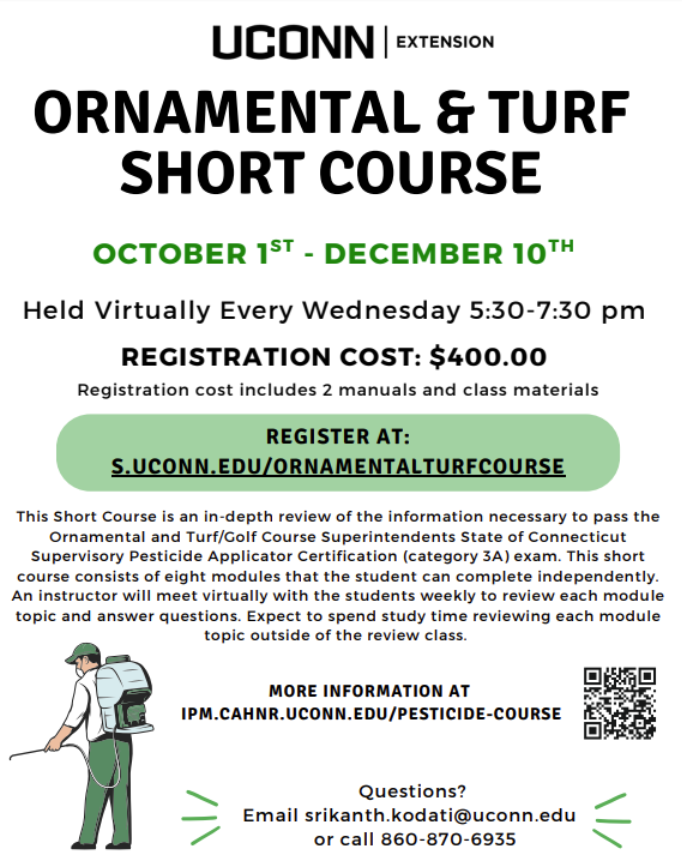
NMFFPC Agritourism Workshop Jan. 29 6:30 PM at NMPL

Categories: Events, Uncategorized
Comments Off on NMFFPC Agritourism Workshop Jan. 29 6:30 PM at NMPL

NMFFPC Agritourism Workshop Jan. 29 6:30 PM at NMPL

New Milford Farmland and Forest Preservation Committee is hosting a seminar at the New Milford Public Library on Thursday, January 29 at 6:30 PM. Join us in learning more about the benefits and impact of Agritourism. Contact steven.kleppin3@gmail.com with any questions.
USDA Farm to School 2026 Grant Proposals due December 5, 2025

Categories: Events
Comments Off on USDA Farm to School 2026 Grant Proposals due December 5, 2025

USDA Farm to School Grant Proposals due December 5, 2025

FARM TO SCHOOL GRANT PROGRAM

The program objective for the FY 2026 Farm to School Grant Program is to:

Improve access to local foods in eligible child nutrition program (CNP) sites through comprehensive farm to CNP programming that includes local sourcing and agricultural education efforts.

Proposed activities should clearly align with the objective and their associated activities and indicators. Careful consideration of proposed activities and indicators will prepare grantees for their progress reporting requirements if awarded.

Examples of project activities that could be supported by FY 2026 Farm to School grants and support the required objective include, but are not limited to:

  • Launching a pilot program that creates opportunities for eligible entities to create farm to CNP initiatives;
  • Incorporating more unprocessed and value-added, minimally processed, locally or regionally sourced meal components into the CNP meals;
  • Readying producers to participate in the CNP food marketplace by providing training on procurement regulations, Good Agricultural Practices, and other food safety-related topics;
  • Improving infrastructure to accommodate new local ingredients or local menu items in CNP meals;
  • Solving distribution bottlenecks that limit the feasibility of sourcing more locally or regionally produced items by working closely with intermediaries (e.g., distributors, food hubs);
  • Integrating agricultural education with career and technical preparation programs to encourage the next generation of agricultural producers;
  • Expanding experiential learning opportunities at CNP sites, such as creating school gardens, developing school-based farmers markets, providing support to agriculture/food clubs, and/or increasing exposure to local farms and on-farm activities;
  • Encouraging increased consumption of fruits and vegetables in CNP sites through promotional activities, taste tests, and other activities featuring local products;
  • Adopting agricultural education curricula that encourage the sharing of Indigenous traditional knowledge between generations, such as native plant varieties and planting practices; and
  • Developing and implementing integrated curriculum to reinforce food and nutrition-based learning throughout the school environment or on a local farm(s).

Under this Request for Applications (RFA), all entities marked with an asterisk (*) must be part of a Partnership to be eligible to apply:

  • State agencies
  • Indian Tribal organizations
  • Child Nutrition Program operators*
  • Local agencies*
  • Agricultural producers*
  • Groups of agricultural producers*
  • Non-profit organizations* (All non-profit organizations must include their 501(c)(3) determination letter issued by the Internal Revenue Service (IRS).)

Applications are due December 5, 2025, at 11:59pm. 
Click here for more information:


New England Regional Milkshed Project Virtual Monthly Workshops with Univ of Vermont

Categories: Events
Comments Off on New England Regional Milkshed Project Virtual Monthly Workshops with Univ of Vermont

New England Regional Milkshed Project Virtual Monthly Workshops with Univ of Vermont

NEW ENGLAND MILKSHED WORKSHOPS EXPLORE PROTECTION STRATEGIES AGAINST FOREIGN ANIMAL DISEASE OUTBREAKS

Agricultural producers of livestock and livestock products and their industry allies are being asked to help shape strategies that can protect local farms and the New England “milkshed” from a foreign animal disease outbreak. Foreign animal diseases (FADs) are not normally found in the U.S., and some have the potential to cause devastating impacts to U.S. agriculture if they occur. A milkshed includes all sources of milk processed or manufactured into dairy products in a region.

Researchers at the University of Vermont (UVM) are hosting a series of four monthly, online workshops, where participants will identify challenges and possible solutions for New England’s dairy industry.

Workshops will be held via Zoom from 1:00 to 2:30 p.m. ET on the following dates:

  • November 12, 2025
  • December 10, 2025
  • January 14, 2026
  • February 11, 2026

Dr. Julie Smith, veterinarian and research professor in the UVM Department of Animal and Veterinary Sciences, is leading this milkshed project and collaborating with dairy farmers, dairy cooperatives, veterinarians, and federal and state regulatory officials. The goal is to gather input and ideas from the workshops that could lead toward reducing the risks of disease spread from livestock and dairy product movements.

“The workshops will explore strategies for reducing harm to the New England dairy industry if a foreign animal disease outbreak occurs anywhere in the United States. We need dairy producer and industry perspectives on what is needed to develop a milkshed protection plan.”

Why Care About Foreign Animal Diseases?

The U.S. enjoys preferential status in the international trade of animal products because of its freedom from many foreign animal diseases. Foreign animal disease-free status benefits animal welfare, the environment, and helps to make food more affordable. However, as long as these diseases exist in the world, it is important to have effective plans to deal with the threats and their consequences if an outbreak occurs.

Register for Workshop

CT DOAG Farm Transition Grant 2026 Guidelines announced.

Categories: Events
Comments Off on CT DOAG Farm Transition Grant 2026 Guidelines announced.

CT DOAG Farm Transition Grant 2026 Guidelines announced.

GRANT OPPORTUNITY TO SUPPORT DIVERSIFICATION AND
GROWTH OF CT’S AG BUSINESSES

The Connecticut Department of Agriculture (CT DoAg) announced the release of Farm Transition Grant program guidance for fiscal year 2026. Connecticut farmers and agricultural cooperatives are eligible to apply with a focus on projects seeking to diversify existing operations or transitioning to value-added agricultural production and sales. All applications are due no later than 4:00 p.m. EST on Monday, January 12, 2026.Funding priorities include projects which increase the availability of livestock processing facilities in Connecticut and utilization of equipment specific to climate smart, sustainable agricultural practices.

Grant applications must fall under one of these categories:

  • New Farmer Micro Grants: Up to $5,000 awarded (25% match required) to support new and beginning individuals or partnerships with one full year to three years of production history, seeking long-term careers in the Connecticut agriculture industry.
  • Infrastructure Investment Grant: Up to $24,999 awarded (50% match requirement) to support farmers in production for a minimum of three years with a need for infrastructure to expand, diversify, and/or transition the farm’s production and operation.
  • Research and Development Grant: Up to $24,999 awarded (40% match requirement) for farms with a minimum of three years of production history to conduct research to evaluate the viability of developing a new product line, service, or market.
  • Innovation and Diversification Grant: Up to $49,999 awarded (25% match requirement) to support farms with a minimum of three years of production history with the production of a new product or service for market or business expansion.

Farm Transition Grant applicants are encouraged to attend a virtual workshop on Thursday, November 20, 2025, from 11:00 a.m. – 12:30 p.m., via Zoom. This webinar will include an overview of the grant program, application components, and submission process. A recording of the webinar will be posted for those who cannot attend the live session. Click here to register for the virtual workshop.

In addition to the virtual workshop, open office hours will be offered virtually providing an opportunity to drop in and ask questions on the following dates:

  • Thursday, December 11, 2025, from 11:00 a.m. – 12:00 p.m. via Zoom
  • Tuesday, January 6, 2026, from 11:00 a.m. – 12:00 p.m. via Zoom

Applications must be submitted no later than 4:00 p.m. EST on Monday, January 12, 2026. Applications and grant guidelines are available at CT DoAg’s website. This is a competitive grant process with applications scored by a review panel. Grant awards will be announced in February 2026. Questions regarding the Farm Transition Grant can be directed to Alison Grabarz at Alison.Grabarz@ct.gov.

Farm Transition Grant is authorized by and funded through C.G.S. Section 22-26k to strengthen the economic viability of Connecticut’s agricultural businesses in times of growth and change.

Farm Transition Grant
Apply Here

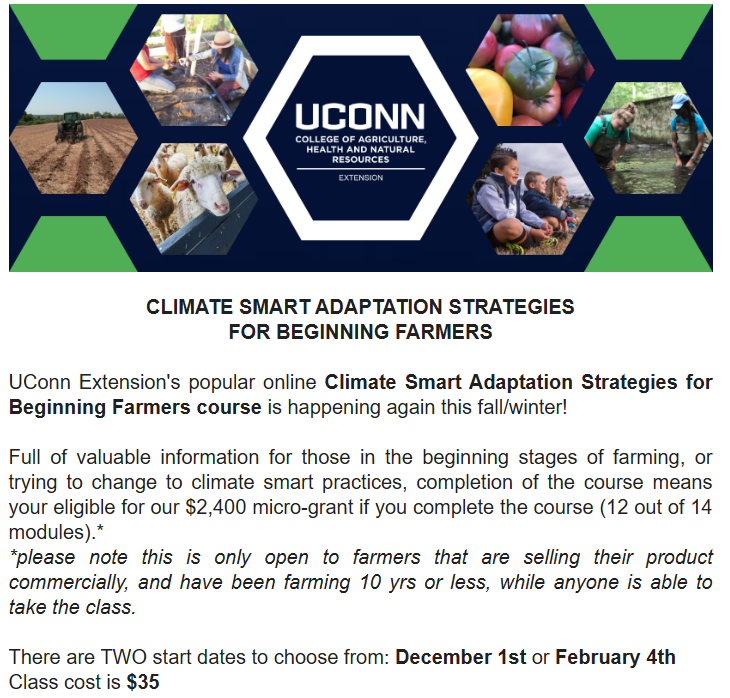
UConn Extension Climate Smart Adaptation Strategies for Beginning Farmers Courses start dates of December 1 or February 4

Categories: Events
Comments Off on UConn Extension Climate Smart Adaptation Strategies for Beginning Farmers Courses start dates of December 1 or February 4

UConn Extension Climate Smart Adaptation Strategies for Beginning Farmers Courses start dates of December 1 or February 4

Take a look at the course modules below!

  1. Intro to Climate Smart Farming*
  2. Climate Smart Soil Health part 1*
  3. Climate Smart Soil Health part 2*
  4. On-Farm Composting
  5. Creating Microclimates Using Fabrics and Mulches
  6. Biological Pest Control and Native Pollinators
  7. Pasture Based Livestock Management
  8. Silvopasture
  9. Managing Water on the Farm
  10. Matching Your Landscape, Climate, and Production
  11. Managing Native Species, Invasive Plants, and Noxious Weeds
  12. Climate Smart Land Conversion
  13. Climate Smart Energy
  14. Financial Resources to Implement Climate Smart Farming*
Participants will learn about the impact of climate change on Connecticut agriculture and discover a range of adaptation strategies through this asynchronous course.  It includes quizzes, videos with other farmers and extension experts, and much more, including support from our Project Coordinator: Baylee Drown.
Please contact Baylee.Drown@uconn.edu if cost is prohibitive and we will work with you to make this affordable.
Sign up

NE-DBIC Dairy Farm Improvement & Modernization Grant deadline Dec. 4, 2025

Categories: Events
Comments Off on NE-DBIC Dairy Farm Improvement & Modernization Grant deadline Dec. 4, 2025

NE-DBIC Dairy Farm Improvement & Modernization Grant deadline Dec. 4, 2025

The NE-DBIC Dairy Farm Improvement & Modernization Grant is now open.

With a total of $750,000 in funding, this grant will support a wide range of projects aimed at improving farm viability, milk quality, worker conditions, economic sustainability, and climate resilience.

Grants will range from $15,000 to $100,000 with a 25% in-kind and/or cash match. 

This grant will fund projects that help dairy farmers improve their operations for long-term success. Projects that take a systems-level approach and that show collaboration with experts or technical service providers will be most competitive. Projects that only replace old equipment without broader improvements to farm systems are not eligible.

Dairy farmers across the Northeast are eligible to apply. Producer associations and technical assistance providers applying on behalf of groups of farmers are also eligible, as are milk buyers/processors focusing on on-farm milk production or transfer.
Grants are available to applicants in all 11 Northeast states served by NE-DBIC: Connecticut, Delaware, Maine, Massachusetts, Maryland, New Hampshire, New Jersey, New York, Pennsylvania, Rhode Island, and Vermont.

Applications are open from October 14 to December 4, 2025 at 2pm. Access the full request for applications here: https://nedairyinnovation.com/grants/farm-improvement-modernization/


NE-DBIC Grants

SARE Farmer Grant Proposals due Dec. 9, 2025

Categories: Events
Comments Off on SARE Farmer Grant Proposals due Dec. 9, 2025

SARE Farmer Grant Proposals due Dec. 9, 2025

NORTHEAST SARE: FARMER GRANT PROGRAM
CALL FOR 2026 PROPOSALS
The Northeast SARE Farmer Grant program provides funds to farmers to explore innovative concepts in sustainable agriculture conducted through experiments, surveys, prototypes, on-farm demonstrations or other research and education techniques.

Farmer Grant projects must:

  • Be led by a farmer who meets Northeast SARE’s definition of a farm
  • Collaborate with a technical advisor.
  • Impact both the farmer Project Leader and other farms in the region.
  • Explore an innovative practice and/or introduce an existing practice to a new audience of farmers.
  • Include outreach activities, or sharing of project impacts and results, to farmers beyond the project team and project participants.
  • Align with proposal criteria.
Farmer Grant projects must generate information or working relationships that are consistent with the Northeast SARE outcome statement and align with our legislative priorities: Northeast agricultural communities honor the holistic connection among land, water, air, and all living beings. Agriculture in the Northeast is accessible and sustainable so all farmers and farm employees can steward resources to ensure sustainability, resilience, economic viability, and a high quality of life.

Legislative priorities:

  1. Maintain and enhance the quality and productivity of the soil;
  2. Conserve soil, water, energy, natural resources, and fish and wildlife habitat;
  3. Maintain and enhance the quality of surface and ground water;
  4. Protect the health and safety of persons involved in the food and farm system;
  5. Promote the well-being of animals;
  6. Increase employment opportunities in agriculture.

The program encourages innovative solutions to challenges in farming and food systems in the Northeast USA, including but not limited to the areas of:

  • Marketing and business
  • Crop production
  • Raising livestock
  • Aquaculture
  • Social sustainability
  • Unconventional agriculture
  • Traditional ecological knowledge
  • and more

This program does not support:

  • Educational programs for the general public who are not involved in agriculture
  • Food donation efforts
  • General public awareness campaigns about agriculture and nutrition
  • Community and school gardening initiatives
Proposals are due no later than 5 p.m. on December 9, 2025. 
Northeast SARE Farmer Grant Administrator, Candice Huber, will be hosting a series of drop-in Q&A sessions from Noon to 1 p.m. EST on Tuesdays in November. Sessions will take place on: November 4, 11, 18, and 25. Click here to register for the Question-and-Answer Sessions.
Learn more